
MOOC Integrating climate change and environmental issues into international solidarity programmes
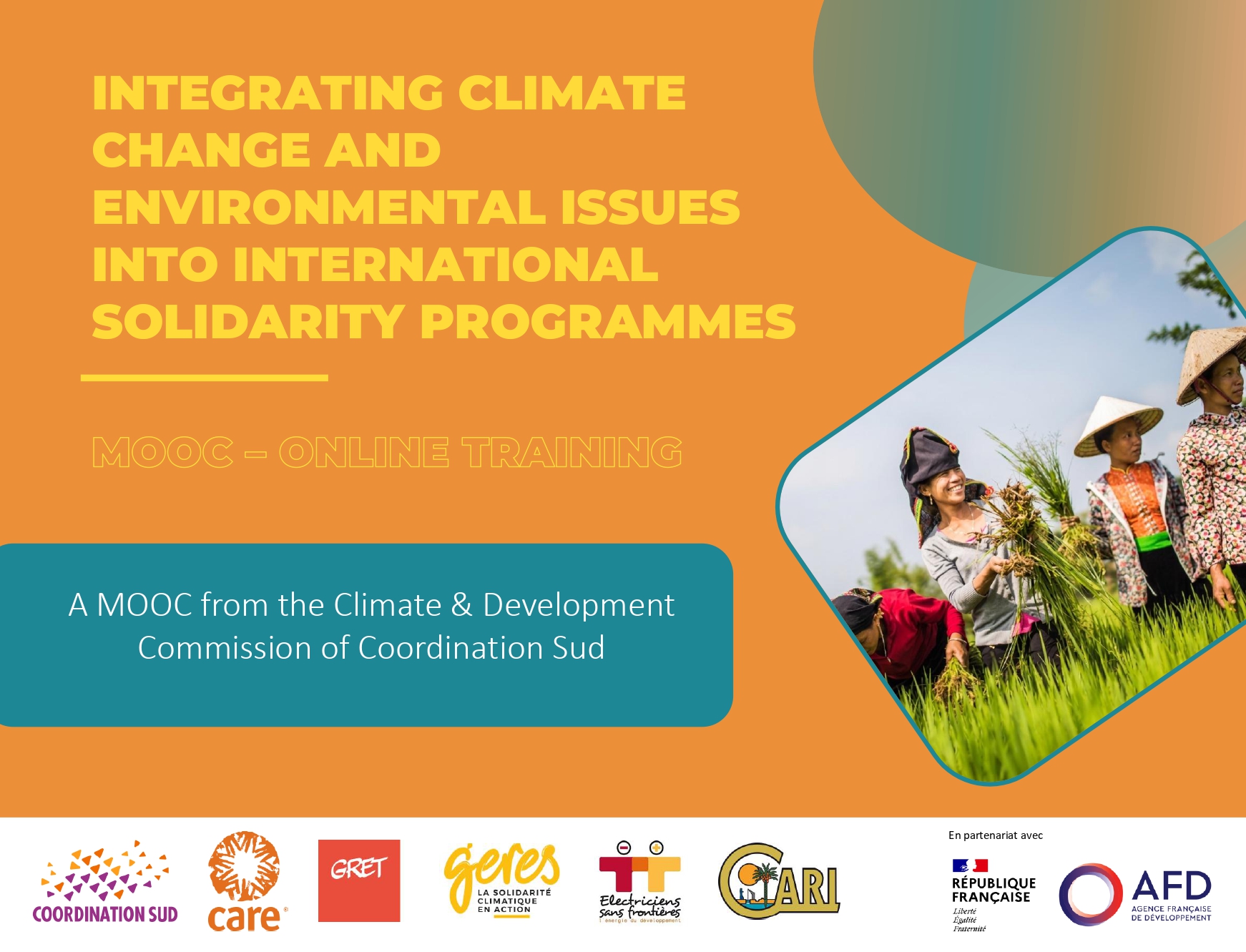
MOOC Integrating climate change and environmental issues into international solidarity programmes
Free access
6 modules / 12 hours
Unsupervised remote learning
Certificate of completion
Offered by: Campus AFD, Commission Climat & Développement - Coordination Sud (Gret, CARE, Electriciens Sans Frontières, GERES CARI)
Available in French, English
36 inscrits
Against the backdrop of accelerating climate emergencies and biodiversity loss, development projects have a vital role to play. Firstly, they must ensure that these emergencies are considered to guarantee the sustainability of the projects carried out. Secondly, they must initiate projects that promote more resilient and environmentally friendly development models.
This MOOC is aimed at a wide audience of stakeholders: development practitioners, civil society representatives, staff of international organisations, elected representatives and local authority officials, experts, teachers and their students, policy-makers and civil servants, and all citizens concerned by the challenges of the global ecological and climate transition.
There are no prerequisites.
By the end of this course, you will have a better understanding of the links between climate, the environment, and development programmes, along with the related concepts. You will be able to consider these links at every stage of a development project's lifecycle, from needs analysis to project implementation.
This MOOC is intended to encourage action and improve existing development programmes, particularly in the fight against maladaptation.
The course structure of the MOOC is organised around the following themes:
1 Introduction to climate and biodiversity issues |
2 Integrating the green transition into development project design |
3 Supporting local stakeholders in adaptation planning |
4 Implementing a plan to mitigate impacts on climate and biodiversity within your project |
5 Monitoring and evaluation measures for adaptation and mitigation initiatives |
6 How to address the social, civic and political dimensions of climate and ecological transitions |
The various sections contain the following: interactive modules, diagrams and infographics, interactive learning activities, additional resources for further study, quizzes to check your understanding of the key points.
At the end of each module, you can put your learning to the test with a final marked quiz for each section.
- You will receive a badge for each section if you achieve a pass mark of 80% in the corresponding quiz.
- You will receive a certificate of completion issued by the AFD at the end of the course if you achieve an overall mark of 80%.
Since 2007, Coordination Sud's Climate & Development Commission has brought together French NGOs to address issues relating to development, climate change and the environment. The Commission comprises over 30 NGOs that are involved in training, peer-to-peer collaboration and co-creation.